At Castle Pines elevations ranging between 6,000 and 6,500 feet above sea level, atmospheric pressure is roughly twenty percent lower than at sea level. Standard factory furnace settings often produce incomplete…
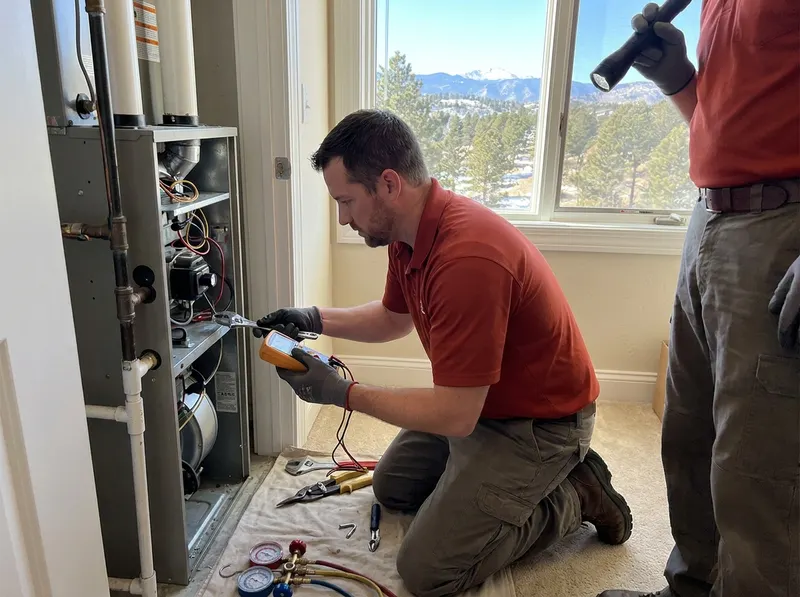
At Castle Pines elevations ranging between 6,000 and 6,500 feet above sea level, atmospheric pressure is roughly twenty percent lower than at sea level. Standard factory furnace settings often produce incomplete combustion, soot accumulation, or frequent pressure switch lockouts due to reduced oxygen density. High-altitude furnace repair focuses on recalibrating gas manifold pressure, adjusting high-altitude burner orifices, and inspecting negative-pressure draft switches rather than simply swapping generic parts.
Homes across Castle Pines North, The Canyons, and The Village at Castle Pines often feature multi-level walkouts and vaulted ceilings that amplify thermal stratification. When an uncalibrated furnace short-cycles during cold fronts rolling over the Ridge at Castle Pines North or near Daniel's Gate Park, upper bedrooms overheat while lower levels rapidly freeze. Rebalancing combustion air and blower speeds ensures consistent static pressure across zoned ductwork in neighborhoods like Forest Park, Hidden Pointe, and Pine Ridge.
Choosing a targeted high-altitude repair over a full system replacement is the most practical choice when the heat exchanger and major blower components remain structurally sound. However, if an aging single-stage unit repeatedly trips safety limits under sub-zero conditions near Elk Ridge Park or Rueter-Hess Reservoir, upgrading to a properly derated modulating furnace may provide better long-term reliability. Every service visit prioritizes safe carbon monoxide levels, reliable ignition, and transparent Douglas County pricing.
Every job gets a firm, written price after a free on-site visit.
Tell us about your high-altitude furnace repair job in castle pines and we'll send a clear, written quote — usually the same day.
 Future Comfort HVAC